
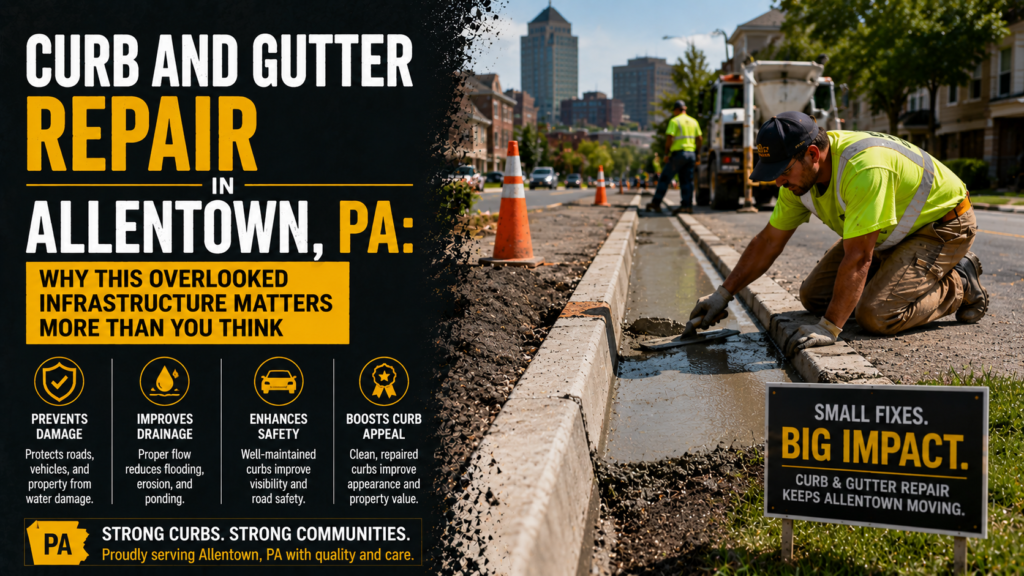
When property owners and city planners think about infrastructure maintenance, attention often goes first to roads, driveways, and sidewalks. Curbs and gutters the concrete barriers and drainage channels that line streets and parking areas tend to receive less attention, yet they perform a critical function in managing stormwater, protecting pavement edges, guiding traffic, and maintaining the structural integrity of the roads and lots they border. In Allentown, Pennsylvania, where weather extremes and aging infrastructure create constant maintenance demands, Curb and Gutter Repair Allentown is a service with real consequences for safety, drainage, and property value.
What Curbs and Gutters Do
Curbs and gutters work together as an integrated drainage and boundary system. The curb is the raised concrete edge that separates the roadway or parking surface from adjacent landscaping, pedestrian areas, or property. It acts as a physical barrier that prevents vehicles from drifting off the paved surface, protects landscaping from vehicle intrusion, and provides a defined edge against which pavement can be placed and supported.
The gutter is the concrete channel running along the base of the curb that collects and directs stormwater runoff from the road or parking surface toward catch basins, storm drains, and the broader stormwater management system. Together, curb and gutter installations control where water goes during and after rainfall events, preventing it from ponding on paved surfaces, eroding landscaping, saturating soil adjacent to foundations, or draining in ways that create safety hazards.
In commercial settings such as parking lots, curb and gutter systems also define traffic flow patterns, separate vehicle areas from pedestrian walkways, and provide anchoring edges for asphalt or concrete paving that reduce the risk of edge cracking and surface breakup.
Common Types of Curb and Gutter Damage
In Allentown’s climate, curb and gutter structures are subject to a range of damage mechanisms. Freeze-thaw cycling is among the most significant. Water that infiltrates cracks in the concrete freezes in winter, expands, and widens those cracks over time. Repeated freeze-thaw cycles progressively worsen surface cracking, spalling, and joint deterioration until the structural integrity of the curb or gutter section is compromised.
Vehicle impact is another common cause of curb damage. Repeated impacts from vehicles mounting curbs, delivery trucks making tight turns, and construction equipment operating near the curb line all contribute to chipping, cracking, and displacement of curb sections. Heavy loads over gutter channels can cause cracking or depression if the underlying base is inadequate or has settled.
Subsidence the settling or sinking of soil beneath a curb or gutter section can cause sections to drop, tilt, or separate from adjacent sections, creating misalignment that directs water away from drains or creates raised edges that become trip hazards. Tree root intrusion, similar to its effect on sidewalks, can lift and fracture curb sections when roots grow beneath the concrete.
Signs That Curb and Gutter Repair Is Needed
Property owners and facility managers should periodically inspect their curb and gutter systems for warning signs that repair is needed. Visible cracking particularly longitudinal cracks running along the length of the curb or gutter, or transverse cracks across the face of a curb section indicates material deterioration that will worsen if not addressed. Spalling, the flaking or chipping of the concrete surface, weakens the structure and creates rough edges that can damage vehicle tires.
Misalignment between adjacent curb sections, gaps at joints, or visible heaving or subsidence of individual sections are all signs of structural problems that may require section removal and replacement rather than surface repair alone. Water that drains away from catch basins instead of toward them standing water on the road or lot surface following rainfall suggests that the gutter channel has been disrupted by settling or damage and is no longer directing runoff as intended.
The Curb and Gutter Repair Process
The appropriate repair method depends on the nature and extent of the damage. Minor cracking and spalling can be addressed through patching with appropriate concrete repair compounds, provided the underlying structure is sound. Cracks should be cleaned, any loose material removed, and repair material applied and finished to match the surrounding surface.
More significant damage sections that have heaved, settled, or cracked through their full depth typically requires removal of the affected section and replacement with new concrete. The process begins with saw-cutting the curb or gutter at the joints to isolate the damaged section without disturbing adjacent work. The damaged section is then removed by hand or with mechanical equipment, the sub-base is inspected and corrected as needed, forms are set, and new concrete is poured and finished to match the existing profile.
Curing is an important final step. Fresh concrete must be protected from premature drying, freezing, and loading during the initial curing period, which typically requires a minimum of several days before normal traffic exposure. This requires coordinating the timing of repair work to ensure adequate protection during the cure.
Curb and Gutter Repair at Commercial Properties
For commercial properties in Allentown retail centers, office buildings, industrial facilities, and multifamily housing complexes curb and gutter conditions directly affect safety, accessibility, and pavement performance. Damaged curb returns at driveway entrances can be a liability risk if they cause vehicle damage or trip hazards. Poorly functioning gutter channels can lead to pavement saturation and accelerated asphalt deterioration in parking lots.
ADA-compliant curb ramps at pedestrian crossings and accessible parking areas are a specific area of curb work that demands careful attention. Curb ramps that have deteriorated, shifted, or no longer meet current accessibility standards must be repaired or replaced to maintain ADA compliance. This is a particular concern for older commercial properties where curb ramps may have been installed before current standards were in effect.
Why Professional Concrete Contractors Are the Right Choice
Curb and gutter repair requires an understanding of concrete mix design, form setting, proper sub-base preparation, and the drainage requirements specific to each site. Mismatches in concrete mix between repaired sections and existing work, incorrect slope in repaired gutter sections, and improper sub-base correction can result in repairs that fail prematurely or create new drainage problems. Professional concrete contractors bring the technical knowledge and specialized equipment needed to produce repairs that are both structurally sound and functionally correct.
In Allentown, where the combination of heavy rainfall and hard winters places significant stress on concrete infrastructure, choosing a contractor with demonstrated experience in local conditions is particularly important. A contractor familiar with Lehigh Valley soil characteristics, frost depths, and seasonal timing constraints brings practical advantages that translate directly into more durable results.
Conclusion
Curb and gutter repair in Allentown is an infrastructure maintenance service with consequences that extend well beyond aesthetics. Properly functioning curbs and gutters protect pavement from edge failure, manage stormwater runoff, define traffic patterns, and contribute to the safety and accessibility of both public and private properties. Understanding the damage mechanisms that affect these structures, recognizing when repair is needed, and choosing qualified professionals to perform the work ensures that this often-overlooked infrastructure continues to perform its essential role reliably and safely.